Archive for the Uncategorized Category

Typhoon shuts down Hong Kong


Bookmark and Share


Nature in Action:

Typhoon shuts down Hong Kong, and reaches China’s island of Hainan. Approximately 300,000 people were evacuated in Hainan in the face of the strongest typhoon to hit China this year as it reached Wenchang city with winds of up to 151 kilometres an hour.

HONG KONG — A powerful typhoon brought Hong Kong to a shutdown Thursday, with financial markets and businesses forced to close.  The Hong Kong Observatory hoisted a number-eight tropical cyclone warning before dawn, triggering the closure of schools and transport services. The number-eight warning was changed to number three at 4:10pm (0810 GMT).

Typhoon shuts down HK, (source: AFP)

In Vietnam, authorities said fishing boats should return to port and urged farmers to harvest crops quickly to reduce potential losses from the typhoon/tropical cyclone known as Nesat/Quiel (Nalgae) , which is expected to reach northern provinces on Friday.

Nesat made landfall in the Philippines on Tuesday, bringing heavy rains and winds that caused storm surges and massive flooding including in the capital Manila.

In the Philippines, tens of thousands of people were still engaged in neck-deep floodwaters Thursday after Nesat’s deadly path across Luzon.

Residents make their way along a street in Haikou (Source: AFP)

Residents make their way along a street in Haikou (source: AFP)

Fire still rages, Shell ready to shut Bukom

(SINGAPORE) Shell - which has already started a two-day sequenced operation to shut down its 500,000 barrels of crude oil distillation capacity - is prepared to shut down its entire Bukom manufacturing site ‘if need be.’

Germany approves a bigger European bailout fund

Nokia to eliminate 3,500 jobs by end of 2012

Nokia announced Thursday that it will cut 3,500 jobs by the end of 2012, as part of a major restructuring effort. The scheduled layoffs are in addition to an announcement in April of eliminating 4,000 jobs.

US stocks slip despite jobs boost

Although the DJIA ends Thursday at 11,153.98 +143.08 points, the Sydney Morning Herald reports that US stocks declined earlier in the day, as losses by consumer and technology companies offset lower-than-estimated claims for unemployment benefits. [editor’s note: The DJIA index ends Thursday up 1.3% — no significant trading movement]

Mortgage Rates in US Fall to Record Low


China Internet Stocks Fall in New York on US Investigation

Chinese Internet stocks tumbled in New York trading after a top US securities regulator said the Department of Justice is reviewing allegations of accounting fraud at firms operating out of the (Sept. 29, Bloomberg)

Furukawa agrees to settle US car parts action

Furukawa Electric, a Japanese car parts maker, has agreed to pay a $200m fine as part of a settlement with US antitrust authorities that marks the first US charges in a global investigation into practices in the car parts … (Financial Times)

Saudis aim to build 16 nuclear reactors to cut domestic oil use

Riyadh: Saudi Arabia, holder of one-fifth of global oil reserves, aims to build 16 nuclear reactors by 2030 as the nation seeks to cut the amount of crude it burns in generators to meet rising power demand, an official said.

Google plans $200 million Asian data centers

HONG KONG - Google plans to invest at least $200 million to build its first three data centers in Asia as it expands its infrastructure to keep pace with the region’s burgeoning Internet use.

China’s great leap towards superpower status with space station test launch

Tiangong 1, China’s first unmanned space module, blasts off in Jiuquan, Gansu province on Thursday.

CEO Survey Shows Less Confidence in US Hiring, Outlook

Top business executives are less confident about the US economic outlook and their ability to hire new workers than in previous quarters this year, according to a survey released Thursday by Business Roundtable. (Wall Street Jounal - blog)

FBI Said to Be Probing Solyndra for Possible Fraud

FBI agents exit the Solyndra LLC headquarters in Fremont, California, on Sept. 8. The company sought bankruptcy protection two days before the raid by Federal Bureau of Investigation agents. (Bloomberg)

Entrepreneurs flee Chinese of Wenzhou city over debts

At least one entrepreneur has killed himself and dozens of others are on the run in China after borrowing money from private lenders at very high interest rates, state media reported on Thursday. (Straits Times)

Protesters disrupt “troika” talks in Athens

Angry Greek civil servants have again been blocking the doors of government ministries in protest against austerity measures. They disrupted the start of talks between ministers and senior officials from the European Union, the International Monetary

Reactor No. 2 cooled to below 100 C

JAPAN - The temperature at the base of the No. 2 reactor at the Fukushima No. 1 nuclear power plant fell below 100 C for the first time since the March disaster, according to Tokyo Electric Power Co.


Imaginary ETrade Global fund advanced 45p


Bookmark and Share


ETRADE Global announced 45% returns for a fund that did not exist. ETRADE Global directors who engaged in unlicensed activities are convicted…

Goldwind (02208) announced yesterday China Securities will receive a Commission license, approved for the company’s public offering of not more than 50 billion face value of corporate bonds.  First issue of nominal value not exceeding $4 billion.

Yuanchang Optical (00155) announced that the company entered into a memorandum of understanding with potential partner Gu Shan Jiangyin joint venture company to be invested for a project of ​​approximately 1000 acres.

Long Yuan Electric Power (00916) announced that, according to preliminary statistics, power generation of 1,744,100 MWh, and annual growth of 1.91%, of which 12.42% growth in wind power.

Major shareholders increase / reduction

Blackrock, Inc. -> China Life (02628) +694 million shares (0.09%) 5.02% shareholding

Brandes Investment Partners -> Weiqiao Textile (02698) +100 million shares (0.24%) 14.22% shareholding

Lazard Asset Management -> Sinoma (01893) +121 million shares (0.1%) 5.07% shareholding

JP Morgan Chase -> Shanshui Cement (00691) +649 million shares (0.23%) 5.08% shareholding

Chi Wen Fu, Century Sunshine (00509) +148 million shares (0.06%) 41.09% shareholding

TOKYO, Sept 6 - Nikkei declined 2.2 percent on Tuesday to a 2-1/2 year closing low

FTSE at two-week closing low

Groupon cancels IPO roadshow set for next week, reevaluating plans due to market volatility.

Dell Inc and China’s top search engine Baidu Inc plan to jointly develop tablet computers and mobile phones, targeting the Chinese market dominated by Apple Inc and Lenovo.

BofA China asset buy-back: A consortium that included the Chinese government was the biggest buyer of a 5 percent stake in China Construction Bank Corp sold last month by Bank of America, the Financial Times reported on Sunday.

Solyndra LLC, a solar panel maker that received $535 million in federal loan guarantees, filed for bankruptcy (the third U.S. solar firm to exit the business due to marketplace pressure from Chinese rivals in recent weeks).

Simplicity: sell

Thinking about what you should do with your “investments?” The only reason you bought them was in the hope that you could sell sometime later to someone else at a higher price. As soon as the likelihood for that to occur is diminished it is always better to sell. How can the decision be so easy? In a non-taxable account, why not sell and preserve your capital, especially when there are no tax considerations?

Holding on to equities won’t make you rich, while declining prices will jeopardize your portfolio health.

For taxable accounts, you can always hedge with options or short the same stock that you are holding long. If you don’t have some form of protection plan in place you’re just gambling unnecessarily… and you don’t belong in the game.

I want you to think about something:  it is nearly impossible for anyone to make enough money to support themselves as an “investor” - the professionals survive by selling services and advice, not from investing. All that matters is when you sell… so, come to your own conclusions about protecting yourself.

The reason I can be so casual is because I’m not in a position to lose anything.

Use those upticks, while you have them to go short… For investors in other countries that was partially taken away yesterday evening. Officials in France, Italy, Belgium, and Spain, all announced short selling in specific financial stocks would be banned starting today (August 12).

After efforts by the European Securities and Market Authority (ESMA) to put together a coordinated short-sale ban across the European Union fell through, the four countries each rolled out their own individual restrictions on the short selling of most major financial institutions.

On September 19, 2008, a short selling ban was instituted on financial stocks in the United States and remained in place until October 8, 2008. You may recall the great interview with Ken Griffin of Citadel in the December 22, 2008 issue of Fortune Magazine. It substantially negatively impacted their portfolio health.

Here’s news from today: Aug. 12 (Bloomberg) — Citadel LLC, the $11 billion hedge fund run by Ken Griffin, raised its stake in Evercore Partners Inc. to 5.2 percent as it ends a three-year effort to build its own investment bank. http://www.sfgate.com/cgi-bin/article.cgi?f=/g/a/2011/08/11/bloomberg1376-LPTK1I0YHQ0X01-4PL3PU21Q9L1O4AM0R0AA0HG12.DTL#ixzz1UqG1RUMi

In the December 22, 2008 Fortune article Citadel is cited as a $15 billion firm after the September/October financial market decline.

But let’s get back on track about short-sale bans…

France, Italy, Belgium, and Spain, also instituted short-sale bans in 2008, roughly around the same time as the U.S. However, these countries kept their bans in place far longer than the U.S. Regardless, it did not stop the decline in bank stocks and simply limits your avenues to hedge, which is useful for retail investors who cannot get approval to trade options.

When looking at the countries that did not ban short selling, such as, Singapore, Hong Kong, Israel and Sweden for example, declines in the share prices of bank stocks took place as well.

Bank stocks weren’t fundamentally attractive at the time so there was no reason to buy them, and with a ban on short selling of financial stocks, it makes it seem a stronger argument that there aren’t any reasons to buy.

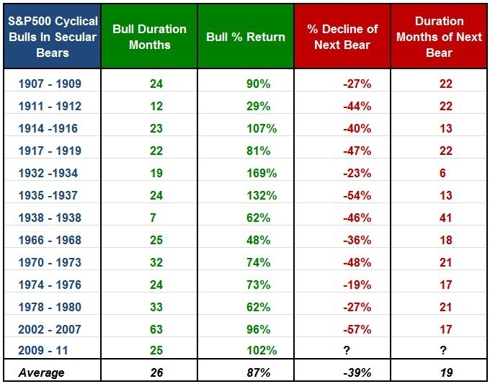
As for bear market expectations, here’s a very limited example:

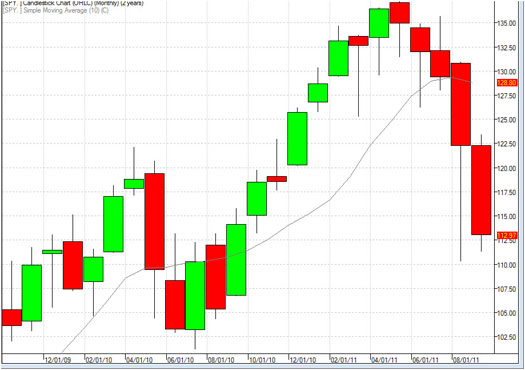
On April 29, 2011, the S&P500 (SPY) reached a closing high of 1363.61.  At the end of January 1998, the S&P 500 was at 1050.5, and during August 1998 was the surprise S&P 500 decline triggered from the financial woes in the Russian market.

I don’t see how the market environment today is any better than August 1998 - and even during the mid to end of the 90s analysts were very concerned that the U.S. stock market was inflated. Remember the “irrational exuberance” comment toward the end of 1996 - yet we’re in much worse global markets and no one thinks irrational exuberance about the U.S. stock market today?

Market snapshot:

The Dow Jones Industrial Average (DJIA) increased 3.9% to close yesterday at 11,143.31. The Standard & Poor 500 (S&P 500) jncreased 4.6% to close at 1,172.64 and the Nasdaq Composite Index increased 4.7% to finish the day at 2,492.68. The CBOE Volatility Index decreased 9.3%. It was another busy day on the New York Stock Exchange, NYSE Amex and Nasdaq, with consolidated volumes totaling 12.99 billion shares, compared with the year’s estimated daily average of 7.8 billion. On the NYSE, for every 12 stocks that jumped up, only one stock was on the losing side.

The DJIA has never ever exhibited this amount of one-day percentage moves within a week (in the last four trading days).  This was the index’s fourth straight day of over 400-points of movement, including the 423 points movement yesterday.The DJIA gained 3.9% yesterday, declined 4.6% on Wednesday, climbed 4% on Tuesday, and decresed 5.6% on Monday. Over the same period, the S&P 500 moved up 4.6%, down 4.4%, rose 4.7% and declined 6.7% a day before that. The Nasdaq gained 4.7% yesterday, declined 4.1% on Wednesday, rose 5.3% on Tuesday and declined 6.9% on Monday.

And you want to hang on because you’re too scared to sell? We’re searching for equilibrium here… frankly, domestic and global economic conditions don’t change in twenty-four periods, so there’s nothing of merit in any subsequent increase after a decline. We’re simply refusing to see domestic and global economic conditions clearly… and to let the truth set us free from all these false assumptions about growth. Even in the boom times of the dot com era actual economic conditions were not good, how people are able to wish the market up from here is beyond me.

Transformation through Financial Metaphor


Bookmark and Share


Recently, I began to look more closely at our mission statement and realized that we actually take people through three levels of transformation. 

The first level we offer is transformation of the trading game—from rules that assure big money wins to rules that give the astute trader a huge edge.  These new rules consist of the Tharp Think concepts that I require all Super Traders to know and understand as the first part of their program.

That’s funny, you want them to know and understand, yet Van Tharp is not a super trader.

In one of my advanced workshops I teach the concept that we all play “games” in life. A game can be defined as any dynamic consisting of two or more players with a set of rules that generally define how the game is won or lost. I’m using the concept of the “trading game” to symbolize a big picture description of all aspects trading.

Don’t forget about the financial education game, too. That’s where the money is, right? If you learn something – I make money. If you do not learn anything of value – I make money. If your trading improves – I take credit (or you credit me for the improvement). If you lose in the markets – I make money. Win – Win – Win –Win!

Level I:  Transformation of the Trading Game

I believe the financial markets are part of a huge game and at the top level, where the rules get set, made, and changed, there is big money.  Big money makes its own rules and profits no matter what you or any individual trader does—they are so much bigger than that.  Big money controls the US government—notice where US Treasury leadership comes from so often and where they go afterwards. Big money also has created a two party political system in which people argue over everything except what is really going on.

Van Tharp actually begins taking some sense, maybe’s been reading the blogs. Ten to fifteen years ago he never made such statements. It never entered into his market beliefs… 

Trading is not easy; however, becoming a trader is very easy.  There are no obstacles whatsoever to anyone opening a trading account. I have long said that if trading were easy, big money would make the entry requirements so steep that it would be impossible for an average person to trade.  Big money might do this through an education and exam system that would weed out most people.  Even today, brokers have to take a Series 7 exam; however, passing this exam has nothing to do with success in the market.

Tharpy makes a nice point here about the lack of entry requirements… at nineteen I had already achieved a Series 7, at twenty I was trading futures contracts and options from my college dorm room.

Big Money’s Rules 

Generally, big money believes the more people that play the trading game, the easier it is for them to make money.  And, as I said before, big money has a set of rules for how it makes money, which has little to do with you making money. I’ve listed some of the rules created by big money here.

  • They profit on commissions, which they take whenever you make a trade, whether or not you make a profit.  In fact, the industry considers it unethical for a broker to take fees based on the profitability of his clients.
  • They make markets and get the bid/ask spread on every transaction.
  • They continually invent new products for you to buy and they profit when you do so.
  • They get paid a fixed fee based upon the amount of assets that they are managing without respect to their performance.

They also get you to believe that you have to follow a certain set of rules for success in the market.

  • Selecting the right investment (i.e., picking the right stock) is everything.
  • When you find the right investment, buy it and hold it for the long term.
  • Spend a lot of time analyzing the market to find the right investment.
  • Listen to experts for advice, including newsletter writers, brokers, and the investment gurus on television.
  • The market will determine whether or not you make money.  You are at the mercy of the market in the short term, but if you hold on, you will prevail.
  • If you do lose money, it’s not your fault.  Find someone to blame and a good lawyer to help you sue them.
  • The market is efficient.
  • Asset allocation is very important (even though most people are not sure what that means).

The New Rules

The new rules are born out of the idea that trading is as much a profession as is any other profession.  Most people spend many years learning their profession, but anyone can start trading today.  Can you imagine walking into a hospital and saying, “I think I’ll try some brain surgery today.”?  It just won’t work.  Yet you can open an online brokerage account, transfer in $100,000 and, suddenly, you are a trader.  Trading with no preparation, however, could be as fatal to your account as performing brain surgery would be on that unlucky patient in the hospital.   (Training is important in medicine, it’s also important in gambling.)

It takes significant time (several years) and a deep commitment to become a successful trader.  I hold a similar belief to author Malcolm Gladwell that the best people in every field usually excel because they have successfully practiced their craft for 10,000 hours.  That means they know enough about their field to produce success.  By working on your personal psychology (which we’ll cover in the second level of transformation), you learn how you produce your own trading results and how you have tended to make everything much more difficult than it need be.

Tharpy makes the point about practice being important, so how many hours of actual trading experience does Van Tharp have? Six or seven hours perhaps… his only experience is in talking about the markets for ten thousand hours!

Learning the key rules is an essential part of this process.  Here are some of the new rules that make up the first level of transformation:

  • You are totally responsible for your performance as a trader; therefore, you should devote significant time to working on yourself in order to be successful. (Yet, Tharpy isn’t a successful trader.)
  • It’s important to know your initial risk in a trade before you enter a position—this allows you to ensure that your trade has a favorable probability for a sufficient reward-to-risk ratio.  In other words, it will help you cut your losses short and let your profits run. (Still, you know how tough this is? Tharpy can’t support himself by trading – yet he’s going to teach you how to train yourself!)
  • Calculate the R-multiples of all your trades; this allows you to think of a trading system by the distribution of R-multiples it generates. (He began using the terminology R-multiples several years ago…)
  • Measure the quality of a trading system by its SQN® score.  The SQN score tells you how easily you can meet your objectives through position sizing™ strategies. (Something he developed a belief in over the last few years, it wasn’t important in his training for most of his market training years back.)
  • Position sizing strategies help you meet your trading objectives. (He’s been saying this since at least 1998 when I noticed it in magazine interviews. Yet, it appears he hasn’t used it himself to reach any kind of trading success.)
  • There are as many objectives as there are traders. (On Sunday June 5th, 20/20 aired a segment on High Frequency Trading. Tharp has not discussed the technology edge in his newsletters. There’s real money to be made there, but he is not a part of it.)
  • You can easily develop a Holy Grail trading system for any one market type; however, it is impossible to develop a system that will perform well in all market types.
  • Your trading system must fit you.  In fact, trading a good SQN system that fits you is probably better than a great SQN system that doesn’t fit you.  Trying to trade a system that doesn’t fit you will likely cause you to make a lot of mistakes and see poor results—regardless of the system’s SQN score. (Tharp has been saying this for years - he just added the SQN thing to his belief. The funny thing is, he doesn’t even have a trading system that fits him.)
  • Great performance is a function of the market, your system, and you as shown in the diagram below where the three circles intersect.


  • Minimize your mistakes and trade at 95% efficiency or better.  You make a mistake when you don’t follow your rules.  If you don’t have rules, everything you do is a mistake.  When traders do have rules, most of them have trouble trading above 70% efficiency (3 mistakes every 10 trades) simply because they haven’t worked on themselves.  Trading at 70% efficiency will destroy the results from a good trading system. (Does Tharp follow this himself? No, because he doesn’t trade for a living.)
  • Trading is a process that can be statistically measured and described if you understand probability and sampling theory.  Within one market type, the mean and standard deviation of your system’s R-multiples will give you a good idea about the future performance of that system under those same market conditions. (Tharp does not have a system that makes him money, other than a system for recruiting people to pay him for stock market education.)
  • Winning is a function of planning, so write a business plan to guide your performance and keep working on that document as you evolve as a person and trader. (A good example of being right under Van Tharp’s wing and not having things work out profitably is the example of R.J Hixson, one of Tharpy’s comrades, who has taken the super trader seminar and who helps out with seminars. In the Van Tharp newsletter R.J. documents the difficulties in being able to meet any goals and profitability. He still has no edge in the marketplace to earn a living from trading. Van Tharp is able to keep his mouth shut on the difficulties of trading for a living because he has not done it, nor is he capable of doing it himself, or providing R.J. with any meaningful results.)

Can you see how the first set of rules can lead to disaster while the second set of rules are a major transformation of the trading game and can lead to success?

My next book will be about trader transformations.  The book will cover the three levels of transformation and include stories from five or six different people who have accomplished a major transformation on each level.  We are accepting submissions now, and we’ll be paying $250 for any chapter that we publish in the book.  If you think you’ve made a major Level I transformation, as described in this article and would like to write a chapter-length article (3000-6000 words), we would love to see it.


There a number of Market Wizards who did not recognize working on themselves as anything meaningful during their interviews. And it becomes obvious how little Tharpy values your transformation so he can have content for his next book.


Van Tharp, through his newsletters, and some of his books has a very limiting view of the world. Everything is a transaction where risk must be limited – in 2004 when he was screaming in his newsletters that the stock market was in “red-light mode” and was due for a crash he completely overlooked the IPO of Google, or the comeback of RedHat Linux share prices, or of Apple computer, which was trading around $28 to $32 per share in April 2004. He cannot see opportunity – holding Google and Apple computer from 2004 would have been more profitable than anything he offers. The proof – he never generated any insight of specific stock portfolio value, and none of his strategies from around the time of his Safe Strategies book was released in 2004 outperformed simply holding Google or Apple computer stock.


My failing, after buying RHAT, GOOG, and APPL I didn’t hold them long enough.

Share


Oneness awakening workshop Tharp review


Bookmark and Share


Tharp is at it again with pushing his oneness blessing course. Perhaps when it gets tougher to sell educational training courses he makes progress getting people to give him money for a lower priced course which gets them to feel good before he can take them for thousands of dollars on a blueprint for trading course.

Don’t you wonder if he offers to teach you how to be a profitable trader and learn all the important stuff to make a fortune then why doesn’t he just record the training sessions and post them online for free? The guys who make fortunes in the investment world aren’t fussing around giving seminars to teach you how to be profitable in your trading.

But since Tharp doesn’t make any money from directly trading the markets, but from selling seminars, so he doesn’t have much else to do. But here’s the interesting thing: This is the first time I’ve noticed in his email newsletter where he states he is trading.

That totally surprised me - normally when pressed for details about his trading he would say he invests passively with his “students” or people he coached to improve their trading ability.

But that answer never really made sense compared to what he offers - So, you’re claiming to teach people how to be great traders and make a living trading in the markets when you have never been a great trader or made a living from directly trading in the markets?

Does that make sense? But some people buy out of hope that someone else has the answer.

How do I know Tharpy doesn’t have the answers?

He’s been wrong about his biggest conviction - that the market was in red light mode and was going to significantly fall and remain depressed in a bear market. His safe strategies for financial freedom book didn’t seem to make anyone any money. And at the time, during 2004, he couldn’t stop himself from promoting his belief in his book and newsletter about a bear market that was going to happen in the near-term. He kept talking about his red-light market mode indicator for several years and saying we were due for a massive bear market and then he dropped it before the bear market arrived in 2008 and 2009, hardly mentioning that he didn’t make any money when the stock market finally did decline - he seemed to be caught unaware just like everyone else. There were no significant developments or insight from his newsletters in the preceding months before the market decline.

And his newsletter profile of a system he was showing for illustrative purposes to be a safe stock buying platform didn’t make any money and he dropped it. The stocks he selected weren’t behaving as orderly as he wanted - the share prices started to decrease - and while he did track some losses in it to show people the actual unflattering results - it showed me that he has no great trading ideas, and even he has trouble implementing a system that fits his style, so how is it possible to believe he can teach anyone how to develop a profitable trading system?

Let’s look at a recent email advertisement he sent: (I’m adding my comments as we go along)

New! Three-Day Oneness Awakening Workshop

One level of transformation, for example, involves adopting the basic model of successful trading that I’ve developed over the years. That means you need to start thinking in term of reward-to-risk ratios (R-multiples), to adopt a trading method that fits you and the current market type, to think carefully about your objectives, and to use position sizing™ strategies to achieve your objectives. These concepts are just scratching the surface of the successful trading model. (Scratch the surface? In interviews and in his newsletters and books for the past ten years he didn’t have much else to say about improving performance.)

Again, that is just one level of the several levels of transformation that I think we provide.

In fulfilling our mission to help others transform themselves, I believe that I need to transform myself first. As a result, I’ve done just about everything that has appealed to me in terms of transformation over the years.

  • I’ve worked through A Course in Miracles (ACIM) twice.
  • I’m an NLP Master Practitioner and an associate trainer. In fact, I did enough NLP until I was convinced I could model any behavioral skill set.
  • I completed the Avatar Course (twice), the Avatar Masters Course, and the Avatar Wizards course (also twice).
  • I attended basic and advanced Landmark Education courses.
  • I went as far as I could go through Scientology (from a former practitioner who had developed her own technology). This was hundreds of hours of transformational work. I stopped when she said I was at a quasi-spiritual level. I didn’t see a benefit from going any further.
  • I completed Byron Katie’s School for the Work.
  • I participated in the Sedona Method course that was recorded and is now sold as a part of the home study. I’ve also purchased and gone through all of the Sedona Method programs and have attended several 7-day Sedona Method retreats.
  • I went through Bruce DuVe’s “transform your body” diets and methods for over nine months.
  • I’ve completed Libby Adam’s transformational mediation course several times.

All of this has been accompanied by massive work on my own in which I’ve followed up on the material from each of these various trainings.

My Journey into Oneness

All of that personal work pales in comparison to the journey I began in early 2008. That journey involved becoming a Oneness Blessing giver and eventually a Oneness Trainer. If I were to rate my personal journey, I’d say that I’ve traveled 1,000 miles, and at least 700 of those miles have been the result of becoming involved in the Oneness Process. I began my transformation journey 30 years ago and started working with the Oneness movement only 3 years ago. 70% of my total progress in the last 30 years, however, has come within the last three years. Oneness has been that significant for me.

Here are a few of the examples:

  • I developed a feeling form of internal guidance after completing ACIM; however, after going through the Oneness Process, I developed a very deep and personal guidance. I can ask that guidance questions and get profound answers whenever I need them.
  • Immediately after becoming a blessing giver (July 2008), our business started to take off dramatically. And while the markets were terrible (and we usually don’t do well during terrible markets), we set record months. (One thing does not necessarily relate to the other. It implies that financial rewards could be forthcoming to the reader.)
  • Most of my staff members really enjoy getting blessings and have become blessing givers. (How about the ones who don’t? They might have an interesting story or perspective.)
  • I developed a new advanced psychological workshop (Peak 203) out of my experiences with bliss while doing the Oneness processes.
  • Over 70% of my Super Traders have become blessing givers and taken the Oneness Awakening course. Now, many of them are pursuing local Oneness activities in their communities. Those that have done so are making huge leaps in their levels of consciousness, which has an incredible effect on their approach to trading and their profitability. (No link to a list of examples?)
  • When I give blessings to our clients during some of the psychological workshops, we usually see huge changes in their ability to understand and integrate the material presented. (In one of Tharpy’s newsletters last year there was an interesting interview with someone who went through analyzing and explaining how he played with his feelings and what he learned from the course - a great personal description - but no figurative pot of gold at the end of the rainbow. In the end he chose not to feel bad. That about sums it up - choose not to feel or succumb to negative or unhealthy feelings.)
  • For my Super Traders in December 2010, I presented a Oneness Awakening Course followed by a one day technical course, Trading in the Now. In January, I traded the Trading in the Now techniques for about 15 days. I don’t normally trade intraday because of lack of time, but I just wanted to prove to myself what was possible. I made around 30 trades and about 80% of those trades were profitable; the SQN® rating of that trading was nearly 10. (Very surprising to me, first time I’ve noticed him talking about trading directly. What he doesn’t say is how much profit there was on thirty trades. Why is this important? Well, when you ask for thousands of dollars to join a seminar on profitable trading, people want to know the dollar value of your experiment. I’m sure you would ask them about the level they trade at for your coaching program, right?)
  • And, most importantly, I’ve had numerous experiences that I would call bliss/rapture that have come from doing the various Oneness trainings. (But he chooses not to list a single one or link to a list of them for reference, so I’ll just guess how meaningful they are then, so it’s like that, huh?)

There is a lot more that I could talk about, but I think you get the idea. (The idea I picked up is that this guy has constantly been searching - and all his talk about developing  good trading habits and such discipline was always a little off base when he struggled for years to address being overweight. I think he finally handled this, but for years it seemed like he was saying I can get you to train your mind to do the most difficult thing in the world, such as, making a living from trading in the financial markets but he didn’t have the discipline to train himself to be more healthy with walking or doing whatever he needed to do lose the excess weight. And in one newsletter from 2004 or 2005 he discussed holding back on entering a transformational life coaching program. It just wasn’t a priority then. Then he raved about it with an endorsement and now it’s on his list as another thing he tried.)

Originally, I became a Oneness Trainer because I wanted to organize the local blessing givers in the Raleigh/Durham/Cary area. The last thing I’d planned to do was offer the Oneness training as a part of our core curriculum through the Van Tharp Institute.  So far, all of our Oneness Courses have been sold out and we’ve produced about 70 new blessing givers through those courses. (I’m still waiting to hear about all those individual miracles and amazing transformations experiences…nothing to share about those 70 folks? I’m going to start selling this oneness awakening stuff, too.)

What Past Attendees Have to Say

Guess what - he lists a few positive comments - no surprise there. Nobody said they didn’t like it or it was a waste of time?

And the quotes he shared had one thing in common - nothing specific about individual experiences. It could have looked like this:

Nothing specific

Nothing specific

Nothing specific

So I decided to look into descriptions of Oneness Awakening and Oneness blessing away from Tharpy and his sales pitch and here’s some of what I found:

The new Oneness Awakening course, taught over two or three days, is designed simply to help a person move beyond the limitations and structures of the mind. When we are identified with the mind– when we filter our experience through our past conditioning– we are in fact not living, but merely existing, merely surviving. When we live within the structures of the mind, we are not actually alive at all. The purpose of life is simply to live– to experience reality as it is– that natural state where the senses are alive, the heart is open, in direct contact with the Oneness in everything.

The course will make use of all of the various teachings and processes that the Trainer has received from the Oneness University and through their own life experience. It is not a course to convey information or to help you to work on yourself, but rather a vehicle through which to show you directly what life is like outside the realm of the mind– that vast peace, stillness, and love that is revealed in direct experience.

This is a very sacred, divinely led process which culminates in the transmission of a very special Deeksha called the Mukthi Deeksha, given through an ancient spiritual technology called Padukas. Padukas are symbols that represent the feet of the Divine, a powerful cross-cultural understanding of surrender. What makes this Deeksha unique is that it comes directly from the Divine and is not routed through the human being. It is a direct transfer from the Divine to the recipient, with the sole purpose of taking the recipient into the state of Oneness and Awakening—that same state enjoyed by saints, sages, and mystics world over.

The Mukthi Deeksha is transferred as part of a three-fold process, which serves to prepare the recipient to receive this Divine benediction. First, the physical body is prepared through dancing, an ancient ritual practiced by all cultures and traditions as a way to open to the Divine. Through this dancing, the kundalini is activated and the chakras are opened. Next, the participant is guided through a process of chanting to fill the mind and unconscious with the presence of the Divine and to clear away any remaining obstacles to the full receipt of the Deeksha. This chanting serves to “program” the mind and energy body for Awakening. Finally, the participants receive the Mukthi Deeksha itself, in a sacred ceremony involving the touching Padukas or other Sacred Religious objects of your own faith.

Once a participant goes through the Oneness Awakening Course, they are initiated as a Oneness Deeksha Giver, and will be shown how to give Deeksha to others.

— and a more descriptive overview of a oneness blessing course —

What is the Oneness Blessing?
The Oneness Blessing (also known as Deeksha) is a non-denominational benediction.   It is the
transfer of Divine energy which over time is designed to bring about the state of Oneness in the
recipient.

What happens during the Oneness Blessing?
The Oneness Blessing initiates a neurobiological change in the brain that enables the senses to be
free from the interference of the mind.  When the senses are unclouded by the mind’s interpretations,
a natural clarity of perception occurs with accompanying spontaneous feelings of joy, inner calmness,
and connection to the Oneness in everything.

How is the Oneness Blessing transferred?  What might I experience?

The Oneness facilitator transfers the Oneness Blessing by placing his or her hands on the crown of
your head, usually for about one minute.  Experiences during the Oneness Blessing vary.  Sometimes they are strong, sometimes subtle, and sometimes delayed until much later.  The recipient may experience a tingling sensation in the head, blissful energy flowing through the body, or nothing at all.  Whatever the experience, the recipient can trust that the process of Oneness has begun.  It is a process that will lead gradually (or sometimes spontaneously) into your own spiritual awakening.

Who can offer the Oneness Blessing to others?
The Oneness Blessing can be given by anyone who has received training by a Oneness Blessing Trainer and participated in the sacred Mukthi Deeksha Process.  Those who have received this training are referred to as Oneness facilitators or Oneness Blessing/Deeksha givers.  The Oneness Blessing giver acts as a channel for the energy to transfer to the recipient.

Can anyone receive the benefits of the Oneness Blessing?
Yes. All adults and children can receive the Oneness Blessing at any time.  The energy will do what it is meant to do for each individual.

What if I wish to become a Oneness facilitator and give the Oneness Blessing to others?
To become a Oneness facilitator it is necessary to attend a Oneness Awakening Course with a Trainer who has attended the Oneness Training Course at Oneness University in India..  Go to the Onenesss Blessing website
www.onenessuniversity.org for more information.

Does the Oneness Blessing adhere to any particular religion or belief?
The Oneness Blessing is not connected to any religion, particular belief or spiritual path.  The Oneness Blessing is given each day to people all over the world, people of all spiritual practices and national origins.  It is not necessary to change one’s religion or adopt a new guru or spiritual master to receive the Oneness Blessing or to offer the Oneness Blessing to others.

Why has the Oneness Blessing come at this time?
Our planet and all of humanity are currently undergoing a major evolutionary transformation.  This has
an impact on our environment, our social structures, and our individual and collective consciousness.  The co-founders of the Oneness University, Sri Bhagavan and Sri Amma, are here to help us with this transformation.

Here’s what I found: The general idea from Oneness University in India is not to charge people — blessings should be shared to help people and communities.

And here is an example of a healing exercise, not sure how closely it matches Oneness protocol but it was from a Oneness themed website:

AN EXERCISE TO HEAL YOURSELF
We recommend this exercise to you. First, notice the hurt. Look within and, in
meditation, examine it objectively. We do not recommend re-living the pain or reexperiencing
the emotional trauma for this can cause it to grow into an awesome
spectacle, an enormous genie let out of the bottle. One can become afraid and
overwhelmed. Therefore, view it objectively. Raise above your personality self. View from
another perspective, like you are watching from outside yourself. See if you can discern
its origin. Soon, many thoughts arrive and the mind begins to sort through these. All sorts
of extenuating circumstances may appear. Emotions may emerge.
In your meditative state, reassure your inner child by projecting love. Breathe in,
using the power of your breath to calm the emotional body. Keep breathing until you feel
calmer. Breathe in and out of your solar plexus. After you feel calmer, begin to breathe in
and out from your heart chakra. Breathe until you feel calmer. After a while, imagine the
breath coming down through the crown chakra, through the top of the head. Focus your
attention at the crown chakra and observe the breath coming in and come from that
center. See or feel light coming down from your Higher Self to you through your crown
chakra. Now, look at the hurt as if from outside your personality. Feel the light from
Higher Self pouring light into the wound. You may need to practice this over several
days, or even months. You will feel when you are ready for the next step. You will become
aware that the light fills the wound. Watch as the physical fabric, emotional fabric,
begins to fill with light. Keep flowing light each day filling the sore spot with light.
Observe each day as the wound fills with light and its colors, for those of you who can
see psychically, turn from angry red, to orange, to yellow, green, blue, purple and finally
to white. Feel the dent filling with light. You may observe strands of light, threads of
light, interweaving as the pit fills with woven strands of light. Keep working in meditation
until the dent completely fills with light.
Sit quietly and appreciate. Appreciate the work you performed on yourself and
appreciate whatever lesson the hurt brought to you. Feel gratitude, dear hearts. We hope
these words soothed your soul, dear hearts. We love you dearly. We are One.

I’m thinking of going to India for two weeks to become a oneness trainer so I can take some oneness business from Tharpy. Besides, I like the idea of helping people.

I hope oneness is just not another thing for Van Tharp Institute to sell, for nearly fifteen years he’s been saying he can tell people how to trade profitably and earn a fortune in the markets - without having done so for himself - and during most of that period he’s never stated in his books the importance of spirituality, or blessings, so his guidance was historically you don’t need that stuff. How about another example? In 1997 when a Forbes journalist went to do a story on trading he listed Tharp’s tips and spoke with the attendees - the journalist wasn’t impressed with his presentation of offering anything of significant value - it just seemed, in the journalist’s opinion, that Tharp was trying to cash in on the dot com, trade from home boot camp mentality that was prevalent at the time.

And the one investment that Tharp did state he was directly involved in from his newsletter from 2004 or 2005? Stamps. Antique postage stamps was where he was putting his money. That’s like saying, “Come to my seminar where I’ll talk to you about making a living trading stocks or earning a fortune trading the financial markets, but where I’m investing my money is in collector postage stamps.”


Bookmark and Share

Citigroup suckers - reverse stock split


Bookmark and Share


For the last few years a friend of mine has said he bought shares of Citigroup for less than $5 per share and that he intends to hold them for the inevitable rise, however, after the 1-for-10 reverse stock split he’s lost his ability to garner substantial profits. And that’s why he bought Citigroup penny stock in the first place - for the potential reward of thousands of dollars from a relatively small investment.

Over the last few years he kept trying to convince me to buy a few thousand shares, and now I’m glad I didn’t. Let’s see if the stock price falls back to the ten to twenty dollar range… I lot of people hate Citibank, and who can blame them? Why should I pay more for the same junk stock?

The low price of Citigroup stock made it attractive to trade - representing as much as 10 per cent of US volume. It was averaging 6.1 per cent of daily US volume in 2011, according to Rosenblatt Securities. Since 2009, Citigroup options were frequently 2 per cent of US monthly volume. Citigroup’s market cap is around $124 billion. But that’s high compared to Apple computer, Google, etc. which actually have some form of business and societal value, whereas, a corporate bank is a corporate bank - and frankly Citibank as a brand, or as a company would not have been missed in a consumer sense if it had been allowed to fail and become bankrupt. But consumers would surely miss Apple computer or Google. People may only be expected to become passionate about banking when it involves a public community bank that serves the public well.

US equity markets exhibited a significant decline in daily trading volumes following a reverse split for Citigroup, by far the most heavily traded company stock.

I think the reverse stock split is negative to the psychology of individual traders - when C was cheap they could buy it knowing it might only drop a point or two, but now the share price is high enough to fall quite a bit - and there’s less upside profit potential compared to the rise of a cheap brand name stock.

*** Update:
Since May 6th to June 17th the share price has moved from around $45 to $38.

comments @ stocktraderdude

Propping up the US stock market


Bookmark and Share


All three US stock market indices are up nearly 10% on the year, with most of that gain occurring in April.


The US economic landscape is much worse now compared to 2004 and 2005 – and bear in mind that in 1994 and 1995 the DJIA was at 4000 to 5000, and in 1992 to 1993 the DJIA was 2000 to 3000, so how can anyone feel positive about natural upward market momentum?


-       Outstanding credit card balances are approximately 900 billion US dollars (How much physical US currency is there worldwide? $850 billion, as Time Magazine reported at the end of 2008)

-       Foreclosures

-       Joblessness

-       Poverty (43.6 million people are classified by the US government as below the poverty line - the highest number in 51 years of record keeping)

-       Uninsured & increasing health care costs (Over 40 million uninsured)

-       Inflation


Does this sound ideal for the US market indices to be at such high levels? Maybe, if we consider that the US stock markets do not reflect the economics of Main Street.


Average Jane Q. Public is never going to achieve wealth in the stock market, nor in real estate, or in anything else – the one thing that will make a difference for her existence is affordable or free health care. If she’s not healthy she can’t viably engage in the pursuit of happiness, nor take care of her family or community.


The average Jane Q. Public family doesn’t have the financial wherewithal to continue consumer spending – they’re still trying to pay off what they spent when times were good! And if the Q. Public family has a family member who is no longer employed, their focus is on the basics of food, other household staples, and getting around town (all of which cost them more!).


Yet we’ve still got folks marketing how to profit in the US stock markets and suggesting continued investment for your retirement security, and as a way to generate wealth. What a silly claim – even with the US stock markets registering gains for this year the value of the US dollar has declined to offset any potential rise in actual portfolio value. Why risk your money just to break-even?


Weekly update


Here’s an example from Tharp and his newsletter – which he promotes to get people to sign up for his expensive workshops. He claims to turn people into super traders and other nonsense. Is he a super trader? No. Does he even trade the markets? No. But he hangs out with people who trade. And he claims they have improved their trading performance from reading his literature. Oh, yeah, because trading books make people money – not!


But isn’t it possible that your “students” made money because the markets have gone up anyway, regardless of how fundamentally bad the economy is? Tharp forgets that in 2004 he was so focused on the collapse of the US stock markets that he was wrong about his secular bear market analysis being the same as a forthcoming severe market decline. And he didn’t personally achieve any of the profits to be gained from the fast declines from 2008 and 2009, nor did Tharpy have anything substantial to say to his newsletter readers during that period. So here’s what he is saying now:


General Comments

We’re in a secular bear market, which means a long term and dramatic reduction in equity valuations. Eventually, we can expect to see S&P 500 PE ratios in the single digits. Fundamentally, conditions certainly seem to support that trend even though the economy can do quite well in some secular bear markets. (Right, you found out after screaming from 2004 that we were due for a massive decline that the US markets did nothing but go up, up, and up, and register record gains in the DJIA to 15,000. That was exactly the opposite you said would happen! Remember in 2004, 2005, 2006 that’s all you could keep talking about – massive decline – massive decline – massive decline, based on your carefully crafted research – which you kept trying to push, and frankly, you make newsletters, not trading profits! You don’t directly trade or profit from any global stock market.)


He goes on to say:

The stock market is in roaring bull mode because of the Fed’s activities; however, those effects are not flowing into the economy. The economy is a disaster. The Fed’s money is just flowing into the stock market, probably largely through big banks investing the new money. Banks certainly are not lending it like the Fed intended. (The Federal Reserve doesn’t print anything. The Bureau of Engraving and Printing does the actual printing. The Federal Reserve just creates book entries as a way to become a creditor and signify they bought US government debt and thereby introduce money into the system. Does Tharpy ever discuss this? Not directly.)


He then states: Here is what is going on in my opinion:

  1. The US economy is in a shambles. The debt is so big that the government cannot fix it. It is only a matter of time before it caves in. Expect the government to default on a lot of its contracts, especially social security. (I say, people need social security, there’s no viable way for their savings to significantly surpass inflation.)
  2. The Federal Reserve is printing massive amounts of money to stimulate the economy, and usually that should work because the banks normally lend out three or more times as much money as they get from the Fed. But right now the rate of lending is at 0.74. The banks are not lending their money; they are putting it into the market…the big banks at least. (We went over this, the Fed creates book entries, they don’t actually print anything – I know Tharpy must know this, but he acts like a typical media reporter when he comments like that.)
  3. US interest rates are very, very low right now because the government, due to its debt, cannot afford high interest rates (nor can the economy). Low interest rates, the US account deficit and our massive debt have crashed the dollar. Expect things to get even worse because one day the world will not accept the US dollar as the world’s reserve currency. (Canada is looking well.)
  4. While the market is in a strong bull period, the overall gain in the major indices this year is not as big as the fall in the dollar.
  5. In this climate, long term investing does not work. You must be a trader, and you must have your psychology together in order to succeed. Trading is not easy; you need to educate yourself and exercise your discipline. (Oh, you mean like you do? Wait – you don’t actually trade any stocks, right? So, you don’t have firsthand experience in actually winning in the markets or making a living from trading. Selling high priced workshops about how to trade, yes, making money in the markets as a super trader or even a competent trader, no.)


Buy a stock trader dude hat – it will keep you warm, and yet when it’s too warm it will offer shade to keep you cool. And it’s a lot more practical than fussing inappropriately with the markets… but act now before the price goes back up to $750 US.


All three hats for $97. (Questions about your order? Contact us at ordering @ stocktraderdude)


______________________________________________________
My clients are...


Bookmark and Share


@stocktraderdude

comments @ stocktraderdude

Commodities and China ADR list

Commodities ADR list:

I was curious to spot anything usual in the investment markets after the earthquake in Japan, but nothing unusual seems to arise, except that India appeared slightly weaker than Japan in terms of index market performance.

Silver, commodities and junk bonds have done fairly well —at least so far in April. Chinese real estate is the weakest real estate area to have been in. Bonds, natural gas and livestock are all very weak areas, but not negative. Base metals and steel are also weak.

The industrial sectors for health care, consumer staples, biotech and energy dominate everything else. However, this is different from last month when the energy related sectors were leading.

China ADR list:

The European countries are gaining strength, with some of them being ranked higher than the US indices. Belgium and Switzerland look strong. Here are the five strongest countries for April:

  1. US Dow 30
  2. Switzerland
  3. Belgium
  4. South Korea
  5. Netherlands

Considering the action in the Forex market last month I was looking for any shifts in the market due to the earthquake in Japan. Here are the strongest currencies for April:

  1. Swiss Franc
  2. Inverse US Dollar
  3. Australian dollar
  4. Mexican Peso
  5. Euro
  6. Brazilian Real and the Canadian Dollar.

APAC dashboard:

Zecco review - worst customer service

I recently came across an ad for Schwab that stated:

I pay next to nothing for trades.

But get next-to-nothing service.

That reminded me of crappy little online only brokerage Zecco. They don’t believe in customer service. I’ve read many negative comments about them posted on their own site in the forums  so I contacted them to see for myself. Zecco customer service is horrible. And they seem cheap. When they make a mistake processing a trade they won’t even credit $50 or $60 for a small mistake. Recommendation: Avoid.


Bookmark and Share


Peak performance 101 home study position sizing review


Tharpy’s newsletter took a break from September 2008 to January 2009 and there was nothing noteworthy or profitable about those particular newsletters during a very quick stock market downturn. So, all the while Tharpy’s been posturing that a trader can make money quickly during a downturn he seems to have not done anything himself, nor have any of his newsletter contributors reported that they generated small fortunes during that period – and Tharp lacked any insight about the decline and upcoming bailout. I guess it surprised him as it surprised us.

Here’s a nice quote from a lady when asked about Van Tharp and the Peak Performance home study course, “He’s yesterday’s magician, if he’s ever even been a magician at all.”

With a number of folks looking for reviews and feedback on Peak Performance home study course and position sizing I figured I’d include a couple of comments from others and relay a little about what to expect from potentially wasting your time with Tharp’s material:


Techniques for haggling with yourself are in the third volume of the Peak Performance Home Study Course: However, I would like to provide you with this introductory information about what your parts may be, their positive intentions, and how you can get to know them better. In particular, I want to explore the intentions of parts that might seem to function to lower your self-esteem by producing fear, anger, depression, or feelings of worthlessness.

In our Peak Performance 101 workshop, we expand on this work by incorporating exercises on an experiential level. And again this work can only be practiced in an interactive environment, such as a workshop, where student and teacher work on individual situations. But you can do the first step in the process, which is the first step our workshop students take. We ask people to do an exercise to determine what parts are in their heads. The exercise is called a “Parts Party.” I recommend you do it about half an hour before you go to sleep, while you are in bed. 

Parts Party

First, since everyone reading this is a trader or wants to be a trader, assume you have a trading part. Bring up that trading part and ask him/her/it the following questions:

1. What are you trying to do for me? What’s your positive intention for me?

2. Who are you in conflict with? What other parts give you the most trouble in your trading?

3. How does this part represent itself? If it is an image, what does it look like and how would someone else recognize it if it walked into the room? If it is a voice, whose voice is it? If it is a feeling, then describe the feeling. How heavy is it? How big is it? And so on.
Ask all your parts to come and let them know you are just giving them a chance to show up and play. But whenever you become aware of a new part, ask it the same questions.

The next morning, after everyone has done the exercise, we ask each participant about their parts. Often the discussion helps others discover additional parts that might not have shown up at the party. Here are some typical responses:

• “I had five parts show up. The trader, whose primary purpose is to make me the best possible trader I can be, and the banker, who is very conservative and in charge of risk management. The little boy, whose intention is to have fun and enjoy life. My family part, whose intention is to love and care for my family and give them lots of time; and my mother. I don’t know what my mother’s intention is, but she is always telling me what can go wrong and making me worry. I know it’s her because it is her voice I hear. The trader, at times, can be in conflict with all of the other parts.”

• “Well, I seem to have four trading-related parts. At least, that is all that showed up last night. One part, the trader whose job is to trade. The second part is the broker part of me whose job is to execute customer orders. However, he’s always giving the trader advice based on what I hear from my customers and that’s usually not productive. I also have a gambler part who really likes the action of playing the market. He is counterproductive. Then I have a part of me that is angry all the time—especially at the gambler part of losing so much money. He tends to disrupt my personal life as well.”

• “I have a skydiver part and a banker part. Neither of them gets along at all. The banker part is very business-like. It makes money by taking low-risk ideas. It manages money well. On the other hand, the skydiver part just loves fun. It loves the excitement. But what it does is very dangerous. It could kill me—both physically and financially.”

• “What I discovered is that I have thousands of parts. I have five advanced degrees and there are parts responsible for each. I’m involved in three different jobs and there are parts involved in each of those. A different part represents each family member—for example, there is not just a father part, but I have a part of me to look after each child. I could go on. And there are new parts being formed each time I want to learn something new. The problem I have is that none of these parts have enough time.”

Spend some time thinking about your parts.  It’s ok if you don’t completely grasp this concept. (I admit, I don’t fully grasp this) As I mentioned this is core material from both the Peak Performance Home Study Course and a very interactive exercise in the workshop. If you just start thinking about this concept and what your many parts may be, I believe it will be a very a positive and useful exercise in self understanding and moving closer to peak performance whether in trading or other aspects of your daily life. (Perhaps, but you won’t make any money in trading – there’s simply no direct link to trading application. What makes me say that? Tharp cannot support himself from trading activities – so practicing this particular exercise doesn’t do much for him either.)


More comments:

“…in the end, the long list of chapters becomes a voodoo ritual - do this, do that and everything will be fine. what? it did not work – perhaps you did not do it exactly as described….”


“FWIW I find Tharp’s well written and measured books at complete odds with the “become a trillionaire in 2 hours with zero risk!” tone of his web site. I am often tempted by the endorsements of PMK (etc) to buy a course but then look at the site and run screaming in the opposite direction. One of the many things I like about TBB is its total lack of such claims.”


“Yet millions flock to purchase trading advice products.” 


When a Forbes magazine journalist visited Tharpy’s seminar operation in 1997 the journalist claimed he felt it was simply taking advantage of the day trader boot camp momentum of the period, not anything substantial in terms of lasting educational value.

Don’t get me wrong, some of Tharpy’s interviews are interesting - or a least they were ten or more years ago, as he did make sense, but then again we all make sense… we just don’t make money in the investment markets… and neither does Tharp. I’ve heard about him managing the retirement account of his operation, but his advertising hype is all about how easy it is to make money in the markets once you address your psychological blocks - yet, he can’t seem to do this for himself - and if he ever did anything significant in trading over the last ten years, even making a small fortune - he would have publicized it - but there seems nothing of merit for him to mention about actual trading.


So, on the one hand - come to my seminar because it is going to be very easy to make money in the markets when I show you how to handle your emotions, but I don’t have any actual results, although I’m an expert on how to overcome negative trading psychology.


Bookmark and Share